
If you’re an upperclassman or someone interested in writing, you’ve probably had Mr. Youngerman as your English, Journalism, or Advanced Creative Writing teacher. If you’ve had his class, then you definitely have heard about his pottery career on the side. Not only does Mr. Youngerman make various types of functional pottery, but he also makes his own glazes.
You might be wondering how he got into all this. While working at a boarding school in Colorado, one of his coworkers (the school’s art teacher) offered to give him pottery lessons in his spare time. Although he struggled at first, Youngerman finally got into the groove, “I wasn’t very good right away, like the first couple times, but then something kinda clicked and I got really into it.” When the pandemic hit and everyone was in lockdown, a time when hobbies flourished, Youngerman was able to borrow a pottery wheel from the school to continue working and perfect his technique. As for his motivation to continue, Youngerman says he likes having something to do, a project to work on when he’s not teaching. In addition to that, he says he’s not one who can just stay still, something most of us at Jemicy can relate to.
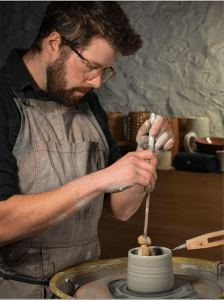
His pieces are made with an assortment of clays and glazes. The clays he uses typically are a variety of red, brown, and white clays. As for his homemade glazes, he took a chemistry class to learn how to properly make glaze. “You mix a few things together and do a lot of testing and experimenting,” he told me when asked about the process. “Glaze is mostly glass. So you have silica and alumina which melt at a really high temperature… they make the glass.” From there you have to add fluxes. These materials lower melting temperatures, as well as change the texture, and sometimes color, of glazes. You then can add additional pigments to the base glaze to make it the color you desire. While this process sounds hard enough on its own, you still have to test the glazes to make sure they work or turn out the way you wanted them to. If not, you have to start all over again and hope for positive results.

When it comes to his pieces, Youngerman is indecisive about his favorite. Typically, he favors whatever project he’s working on at the moment. “I feel like I’ve gotten better and better, pretty much over the past year especially.” As he continues to make, he continues to learn, and even jokes about disliked pieces of his from a year ago. “I look back at stuff from a year ago and it’s like, ‘Ew. Gross!’” At the moment, however, Youngerman’s favorite piece is a porcelain cup he made with a matte green glaze on it.
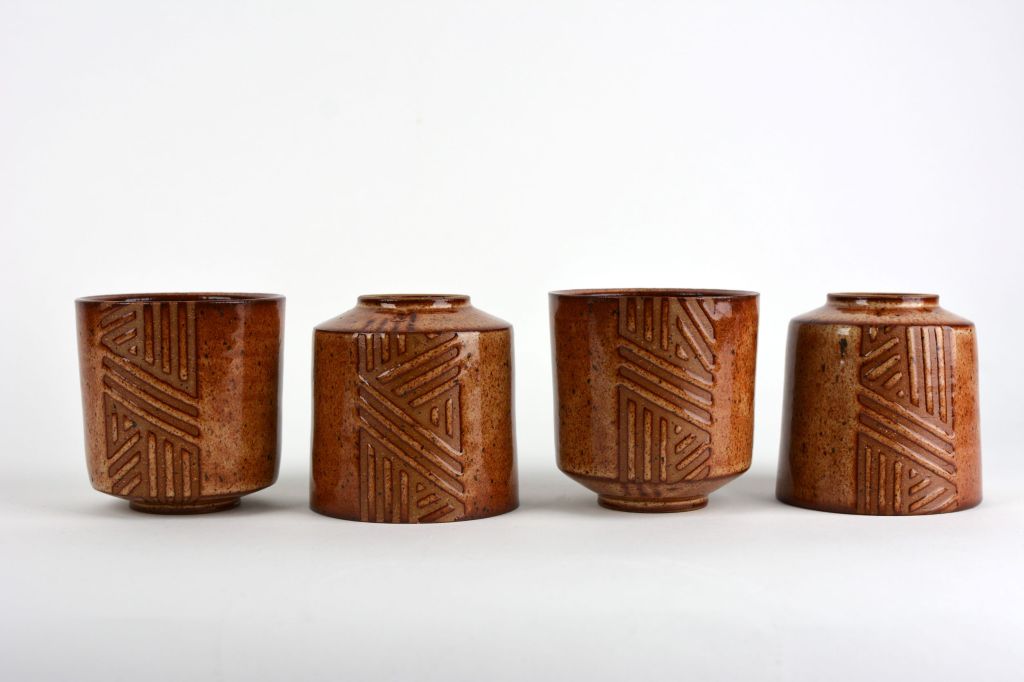
In addition to his online store where he promotes and sells his pottery, Youngermans’ work can also be found at Good Neighbor, a small coffee shop on Falls Road, and B. Willow, a plant store in Remington. While this is impressive on its own, Youngerman hopes to expand his business, and one day sell to restaurants. One of the main things he likes about pottery is its functionality and the personal touch a homemade mug gives, compared to a machine-made one. When asked if he would ever go a more sculptural route, Youngerman was open-minded but leaned his answer more towards no. “I’d like to try some different things… but [what] I like a lot [is] the functional part.” He also notes that he finds it really satisfying to throw a bunch of mugs of the same size and design into the kiln to eventually sell.
 MOOSE PRINTS
You must be logged in to post a comment.