
The hawk is above us as we pass through the dead vines of winter. She wanders here and there through the treetops but always begins following us again. She always sees the squirrel before we do, and when she stops following, we know she found something. We tug on vines and beat trees as she stares down at us. Eventually, a small gray squirrel darts up the tree, and she is ready. Our job is to make sure that the squirrel doesn’t jump off the tree. Her job is to grab the squirrel, and she does, but it wiggles and bites as they both fall to the ground. The squirrel runs into the bushes and the falconer calls down his hawk. With extraordinary silence, the hawk lands on his fist and takes the food resting in his palm. The three of us continue through the woods.
Falconry is “the art of training hawks to hunt in cooperation with a person.” (Webster). While this definition is correct in many ways, there is so much more to the sport. First off, falconry involves all raptors (a bird of prey) not just hawks. This includes falcons, buzzards (red-tailed hawks, etc), eagles, sea eagles, raptors that are in their own individual grouping, and yes, even owls. The rest of the definition is pretty spot-on, but much more goes into falconry that cannot be summed up in a single sentence.
I found out I was interested in falconry after going to a talk at Irvine Nature Center. I quickly began to learn more about the sport, but COVID got in the way of me meeting people. During quarantine, I was able to do a lot of research and reading on falconry. I have been working to get my falconry license and pursue the sport. I’ve been on hunts with various falconers and learning about the different ways people hunt and care for their birds.
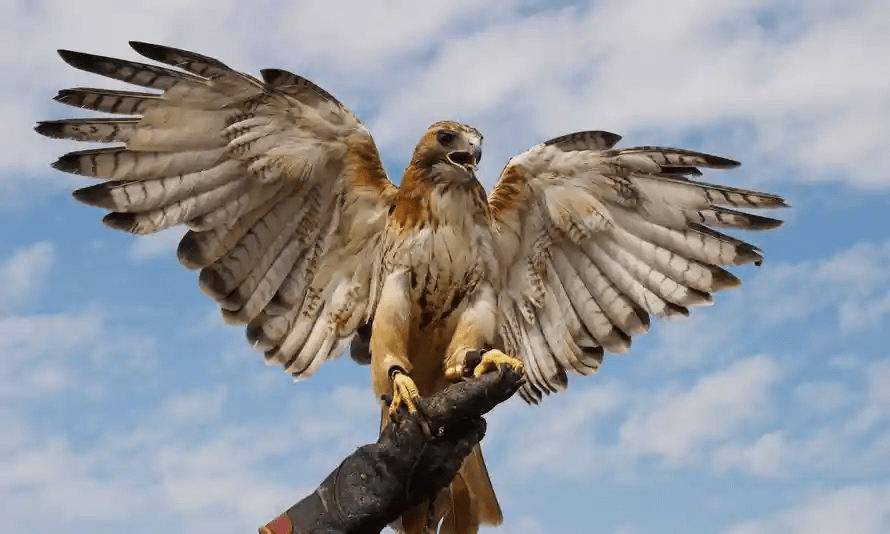
In the U.S., falconers are usually catching a first-year bird (meaning that the bird hatched the previous spring but is now able to fly and hunt on its own). These rules were put in place by the federal government. This usually differs from place to place. For example, in the U.K. catching wild birds is illegal and the only way to obtain a bird is from a breeder. This is interesting because the U.K. has this as their only rule. On the surface, it seems cruel that falconers catch a free bird and then train it. In reality, it isn’t cruel at all and falconry turns out to actually be a mass conservation effort. 70% of first-year red-tailed hawks die their first winter. By catching, training, and hunting with the bird through the winter the success of that bird is far greater than ever before. These animals are still wild animals, meaning that falconers are able to release the bird at the beginning of spring if they so desire. When dichloro-diphenyl-trichloroethane (the pesticide also known as DDT) was prevalent in the U.S. and peregrines were endangered, falconers were silently the leading force in that conservation effort.
While conservation is important and extremely useful in many cases, falconry at its core is a hunting sport. In hunting, what firearm is used depends on what quarry the hunter is going for. This is the same for falconry, different birds are able to hunt different types of animals. In Maryland, there aren’t as many large birds to hunt, meaning that most falconers here don’t hunt with falcons. Maryland has tons of squirrels and rabbits meaning it is a good place to hunt with a hawk. Other than being two entirely different groups of birds, falcons have longer, thinner wings and specifically hunt birds. Hawks and buzzards, on the other hand, are better for hunting mammals with most being able to glide, unlike a falcon which has to constantly flap its wings most of the time. Essentially, the way they hunt is extremely different from one another.
Because of the amount of knowledge it takes to know about even a single species of bird, rules had to be made. Put in place by the Department of Natural Resources, falconry involves an apprenticeship program, where I have to find someone willing to sponsor and teach me for two years. It also involves getting a falconry license, a hunting license, and even a facility inspection by the Department of Natural Resources before I go to catch the bird. As an apprentice, I only get a selection of two different species to train, the red-tailed hawk and the American kestrel. Only last winter, I was able to find a sponsor. That small part alone took vigorous research to find, and I had to do annoying twists and turns throughout the entire process and I still don’t have my license yet.
The fact of the matter is that it is too hard to become a falconer in the U.S. and it becomes even more difficult in Maryland. Getting a falconry license is pretty easy compared to the rest of the requirements. Those applying need to take a test and only need to get an 80% to pass. Each test in each state differs, but it is mostly asking about different species, general care, hunting, and medical health. It is the requirements before the license that is so time-consuming.

Unless someone already knows a falconer it is almost impossible to find them (mostly because they are just normal people who do it as a hobby). Falconers in Maryland also tend to be very secretive about what’s on their property and for good reason too. There have been dozens of reports of people sneaking onto a falconer’s property and releasing their bird, or even worse vandalizing the property in the process. The Department of Natural Resources does have a list of falconers to contact on their website, but that page is buried deep in the website and a lot of the phone numbers are expired or changed. Even if someone does contact the Department of Natural Resources for information they don’t trust that they are serious about getting into the sport. Every single phone call I made to either a potential sponsor or the Department of Natural Resources (DNR) I had to go through this conversation:
“You know this is a hunting sport, right?”
“Yes.”
“The bird isn’t a pet.”
“Yes, I know.”
“You aren’t doing this for a pet owl, yeah?”
I then sigh quietly.
“No, I am not.”
Let’s just say the conversation continues down that slippery slope. This isn’t necessarily the DNR’s fault, the reason they are like this is that they probably get several calls asking about pet owls in falconry. At the same time, by immediately questioning and judging the person interested in the sport about how they are already unfit to be a falconer, it doesn’t give the potential falconer a chance to explain what they know and maybe even have an interesting conversation with the person at DNR. In the time I was answering these questions, I could have been asking my questions and maybe learning a bit more about the sport.
Eventually, DNR will give the correct information and they will say to get a sponsor and have them sign a document so the potential falconer can then take the test. What most people fail to say is that a hunting license is needed. I have never hunted, and falconry is extremely different from conventional hunting. The path to getting a hunting license is equally as difficult if not more difficult than getting a falconry license, especially for someone who has only gone to falconry hunts in parks and neighborhoods.
It is extremely difficult to become a part of that world. Just getting the correct information on what to do is confusing. I spent so much time just trying to decipher what to do next on the DNR website. I then had to go through an online program in order to get a certification so I can then go to a field day test in person. The schedule for the field day is so booked that if I don’t pass, I’ll have to wait till early fall in order to try again. It’s just another annoying sequence of events that someone has to deal with in an already stressful process.
There must be ways to fix these issues, right? Specifically in Maryland, falconry is a declining sport. My sponsor told me once that there used to be over 300 falconers in the state and today it’s only around 150. I do think this has to do with the falconers being so secretive. Treating the sport as a special club immediately lowers the chances of people finding out about falconry and other falconers in the area. I only started meeting tons of falconers when I already had a sponsor, which isn’t as helpful to the people trying to find a sponsor. The only way to fix this is by having the newer generation of Maryland falconers be more open to others.
While the falconers do have some control over what happens, it’s really the government who makes the rules. In order to make it easier for all falconers to start falconry, the U.S. needs to combine the hunting license with the falconry license. There is not much crossover when it comes to conventional hunting and falconry. Around 95% of the hunting course did not contribute to my education about falconry and the stuff that did help was the small animal behavior portion of the course. Combining the licenses immediately makes it easier for non-hunters to get into the sport.
Falconry is still relatively recent in the U.S. and there is much that needs to change in order for the sport to be able to thrive and be more widely known. With many raptor populations on the decline in recent years, it’s even more important that falconry is more widely found.
 MOOSE PRINTS
You must be logged in to post a comment.