The views, information, or opinions expressed this piece are solely those of the author and do not represent those of The Jemicy School and its employees.
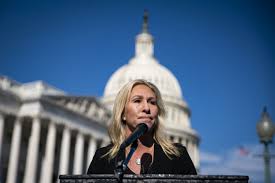
It’s hard to talk about Congresswoman Marjorie Taylor Greene (R-Georgia) without making ad-hominem attacks; her political career has been speckled with depravity, conspiracy theories, and bad-faith arguments and attacks since she first set foot in Washington (and even before).
And while figures like Mrs. Greene have existed on the fringes of the American political landscape from its inception, the fallout from the recent capitol insurrection has raised questions about what exactly should be allowed in the halls of that building. Should Marjorie Taylor Greene and potentially others like her be criticized? Deplatformed from social media? Removed from office? Held criminally or civilly liable?
Most of the criticism surrounding congresswoman Greene has to do with her conspiracy theories. Whether it be following and harassing and threatening Parkland shooting survivor David Hogg, to 9/11 conspiracies to claiming that “Space Lasers” started the California wildfires, it’s clear that Marjorie Taylor Greene is either entirely misinformed or a good actor. The things that she believes and decides to spread publicly would be despicable if they weren’t so hilarious; Mrs. Greene is a spectacle, just like President Trump was.
If Congresswoman Greene is louder, more frequently misinformed, and more egregious in her misinformation, it is only because pushing the envelope further is how hack politicians stand out after four years of the country being gaslit into believing that Trump is normal or representative of the population.
Following her repeated efforts to undermine the 2020 election with misinformation campaigns and conspiracy theories, Twitter stepped in and suspended her account. Twitter, of course, is a private company, meaning they are well within their rights to ban whomever they please, and Mrs. Greene’s tweets were in violation of their Terms of Service. But Twitter and other social media platforms are notorious for selective application of their rules. While they were well within their rights to ban Mrs. Greene, were they acting ethically when they did so?
It’s a difficult question to answer because we’re only now dealing with this. Never before in the age of Twitter have politicians used it to propagate falsehoods and political unrest so blatantly. But that speech is protected by the First Amendment, and even if Twitter isn’t bound to the constitution, some argue that banning a politician for political speech is a slippery slope. Twitter, historically, hasn’t acted ethically. And the fact that so much discussion over that decision is ongoing is a big win for Twitter. But is Twitter’s financial interest in the best interest of the country? Was it right in theGreene situation but not all situations? I suppose hindsight will be illuminating in this area.
In the wake of Marjorie Taylor Greene’s busy few months, some have advocated for a stance more hardline than a Twitter suspension. California Representative Jimmy Gomez introduced a resolution to expel her from the house in late January of this year, and saw support from a number of Democratic House members including Representative Bush, who moved offices earlier this year after an altercation with Mrs. Greene when she refused to wear a mask.
Removing a congresswoman from office should require, in my opinion, mounting evidence of criminal wrongdoing or negligence. Political speech, as a rule, should not be the basis for that removal. And to be fair, the argument for criminal wrongdoing and negligence is a compelling one here. Marjorie Taylor Greene’s close friend attended the deadly capitol insurrection, and she attended the rally immediately before the riot, telling supporters to “fight for Trump”. On January 21st, Mrs. Greene and two other conservative Congress people denied allegations that they had given an abnormal number of tours of the capitol as some sort of reconnaissance for the insurrection. On the morning of the attack, Mrs. Greene tweeted that today would be conservative Americans “1776 moment”.
If an investigation is conducted and evidence shows that Marjorie Taylor Greene acted recklessly and in violation of the law, then we can only hope that she is removed from office. But while her conspiracy theories, bigotry, and cartoonishly evil stupidity are disturbing, they alone are protected speech and do not meet the standard required to remove her from office.
We can hopefully all agree that something needs to be done to prevent another congresswoman Greene. But the power needs to ultimately be placed in the hands of her constituents. If Georgia voters want her to represent them, it is unproductive to go subvert the will of the people by removing her from office; we should instead work to help educate people about why conspiracy theories, transphobia, harassment, and bigotry aren’t virtuous.
 MOOSE PRINTS